Trust has become a measurable part of remote hiring
Remote hiring changes one of the most familiar assumptions in recruitment: that trust can be built through physical presence. In a traditional interview, a hiring manager may meet a candidate in an office, observe how they interact with colleagues, and form impressions through several informal encounters. Remote recruitment removes much of that context. The hiring process must therefore replace proximity with evidence.
This does not mean trying to recreate an office interview through a video call. It means designing a recruitment process that gives candidates meaningful opportunities to demonstrate how they think, communicate, solve problems, collaborate, and make decisions. The strongest remote hiring teams do not ask recruiters to rely more heavily on intuition. They create more consistent ways to evaluate evidence.
Trust is particularly important when employees may work independently across different locations and time zones. A candidate may be highly capable but not naturally impressive on camera. Another may be confident and articulate during an interview but struggle with planning, collaboration, or execution. Remote assessment helps companies distinguish presentation skills from the capabilities that actually matter for the role.
Replace impressions with multiple sources of evidence
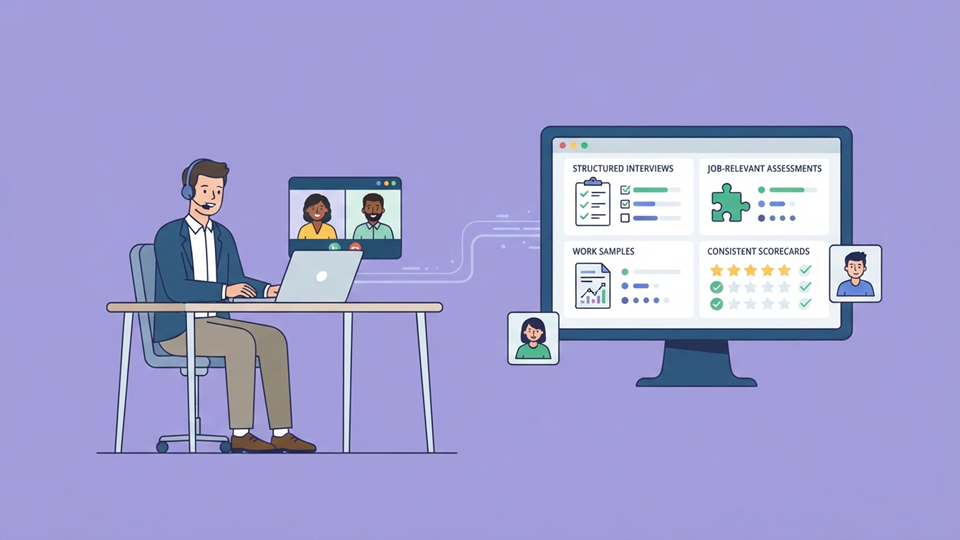
The most reliable remote hiring processes use several assessment methods rather than allowing one interview to determine the outcome. A video interview can reveal communication style and help establish rapport, but it is only one data point. A structured scorecard, work sample, skills assessment, and references can provide a broader view of the candidate.
For example, a remote customer success role might be assessed through a structured interview, a written response to a hypothetical customer issue, a role-play session, and questions about prioritization. A software developer might complete a practical coding exercise, explain technical decisions, and discuss how they would collaborate asynchronously. A marketing candidate might analyse a campaign brief and present a recommendation remotely.
The objective is not to create an unnecessarily long recruitment process. Each stage should answer a specific question. Can the candidate perform the core work? Can they communicate clearly? Can they operate independently? Can they collaborate effectively? Can they adapt when information is incomplete?
Structured evaluation also reduces the risk of hiring based on personal chemistry. Research from industrial and organizational psychology has consistently shown that structured interviews, where candidates are asked comparable questions and evaluated against defined criteria, tend to be more reliable than unstructured conversations. In a remote environment, this consistency becomes even more valuable because informal observations are limited.
Use job-relevant assessments
Assessment should be directly connected to the role. A company hiring an account executive should not rely on a generic personality test to decide whether someone can manage a sales pipeline. A practical exercise involving discovery questions, objection handling, or account prioritization is more relevant.
The same principle applies to cognitive and psychometric assessments. Tests can provide useful additional information about reasoning, attention, or behavioral preferences, but they should complement job-related evidence rather than replace it. The strongest approach combines different forms of evidence and gives each one an appropriate weight.
Design remote interviews for evidence, not performance
Video interviews can create a misleading impression of objectivity. Everyone appears in the same digital rectangle, but candidates may have very different levels of experience with video calls, different internet connections, different home environments, and different cultural communication styles. A polished camera setup should never be confused with professional capability.
Remote interviews work better when interviewers prepare questions in advance and define what a strong answer looks like. Instead of asking, “Tell me about yourself,” interviewers can explore specific evidence: “Tell me about a project you managed with limited supervision. How did you organize the work, communicate progress, and respond when priorities changed?”
Behavioral questions are particularly useful when they are connected to the actual demands of remote work. Candidates can be asked how they handled an ambiguous assignment, resolved a disagreement without an in-person conversation, or maintained visibility when working independently.
Interviewers should also avoid treating communication style as a simple proxy for trustworthiness. Some candidates think carefully before answering, while others respond quickly. Some communicate with enthusiasm, while others are more reserved. The relevant question is whether the candidate provides credible evidence of the required behavior, not whether they resemble the interviewer.
Evaluate how candidates work when nobody is watching
One of the central challenges of remote recruitment is assessing autonomy. Companies often say they want self-directed employees, but then evaluate candidates almost entirely through conversations. A practical exercise can provide much stronger evidence.
For instance, a candidate could receive a realistic but limited brief and be asked to produce a deliverable within a defined period. The task should be proportionate to the role and should not become unpaid production work. The company can then evaluate the result, the candidate's assumptions, the questions they asked, and how they communicated progress.
The process itself can reveal useful information. Did the candidate clarify an ambiguous requirement? Did they identify the most important priorities? Did they communicate when they encountered a problem? Did they submit a thoughtful solution rather than simply producing something quickly?
For a project manager, this might involve creating a short delivery plan from incomplete information. For a designer, it could involve explaining design decisions for a fictional product problem. For an operations specialist, it might involve prioritizing competing requests. For a developer, a realistic technical task can reveal not only coding ability but also how the candidate approaches requirements, testing, and trade-offs.
Remote companies should also assess asynchronous communication. Written communication is a significant part of distributed work, from project updates and documentation to customer messages and internal discussions. A short written exercise can reveal clarity, structure, judgment, and attention to detail in ways that a video interview cannot.
Build a consistent trust framework for hiring decisions
Trust should not depend on one recruiter's personal interpretation of a candidate. A consistent framework helps hiring teams compare evidence and identify gaps before making a decision.
A useful scorecard might evaluate five areas: role-specific capability, communication, autonomy, collaboration, and adaptability. Each area should have observable criteria. For example, “strong autonomy” could mean that the candidate demonstrates how they prioritize work, identify blockers, and communicate risks without requiring constant supervision. “Strong collaboration” could mean that they can explain how they involve others, handle disagreement, and maintain alignment across different working styles.
Each interviewer should record evidence independently before discussing the candidate with the rest of the panel. This reduces the risk that the first strong opinion dominates the conversation. It also makes it easier to distinguish facts from impressions.
A useful decision discussion might sound like this: “The candidate demonstrated strong analytical ability in the exercise and gave a clear example of working independently. We still have limited evidence of how they handle disagreement in a distributed team.” This is more useful than saying, “I liked them,” or, “I am not sure they would fit the team.”
Technology can support this process by centralizing interview questions, assessment results, scorecards, candidate feedback, and decision records. The technology does not make the decision, but it can make the evidence easier to organize and compare.
Make remote assessment fair, transparent, and candidate-friendly
A process designed to build trust with employers should also build trust with candidates. Candidates are more likely to engage with assessments when they understand why an exercise is being used, how long it should take, and what capabilities are being evaluated.
Companies should avoid excessive assessments, unclear instructions, and tasks that appear unrelated to the role. A long process can damage the candidate experience, particularly when candidates are applying to several remote positions at the same time.
Accessibility also matters. Candidates may have different technical circumstances, disabilities, communication preferences, or responsibilities at home. Providing clear instructions, reasonable time limits, and appropriate alternatives can improve both fairness and the quality of the evidence collected.
Remote hiring also creates an opportunity to make recruitment more consistent across geographic locations. Instead of giving candidates in one city an informal advantage because they can attend additional office meetings, companies can use the same structured process for candidates in different regions. This can expand the talent pool while making evaluation more comparable.
The best remote hiring processes therefore combine human judgment with structured evidence. They use interviews to understand context, assessments to explore relevant capabilities, work samples to observe performance, and scorecards to make decisions more consistent.
For companies building distributed teams, this approach creates a stronger foundation for trust than trying to judge whether someone simply “feels right” during a video call. Platforms such as Zamdit can help organizations bring assessments, interview questionnaires, scorecards, candidate comparisons, and collaborative hiring workflows into one recruitment process, making it easier to evaluate candidates based on evidence rather than proximity.