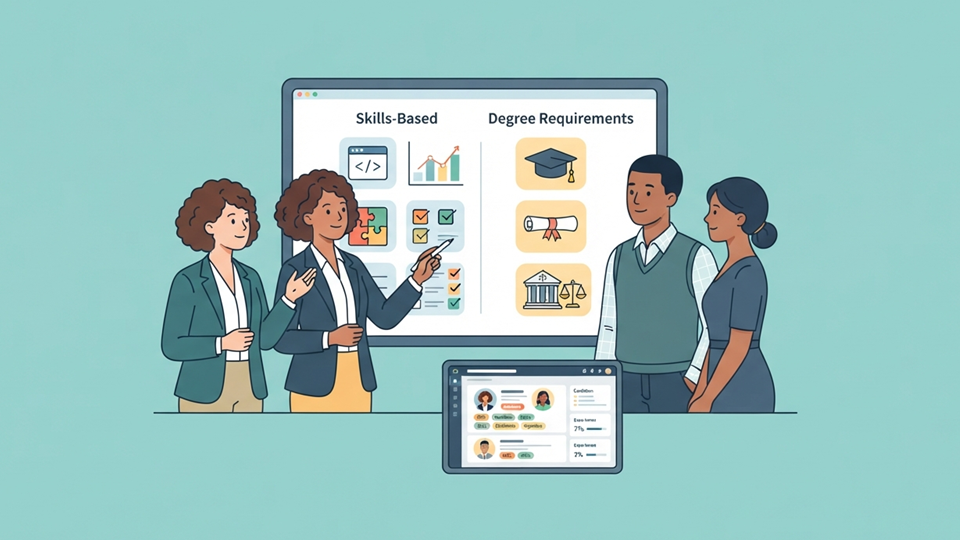
Why skills-based hiring is gaining ground in 2026
For years, a university degree acted as a convenient screening mechanism. Employers could reduce a large applicant pool by requiring a bachelor's degree, even when the role itself did not depend on knowledge acquired at university. In 2026, that approach is increasingly difficult to justify for many positions. Talent shortages, changing technology, alternative education pathways and pressure to widen candidate pools have pushed skills-based hiring much higher on the recruitment agenda.
Skills-based hiring focuses primarily on what candidates can do, rather than where they studied or which credentials they hold. That does not mean qualifications have become irrelevant. Instead, employers are becoming more deliberate about distinguishing between roles where formal education is genuinely necessary and roles where it has traditionally been used as a proxy for capability.
Large employers have already moved in this direction. Companies including IBM, Google and Accenture have promoted alternative pathways into technology and professional roles, while major employers such as Walmart have removed degree requirements from some corporate positions. Governments and public sector organizations have also reconsidered degree requirements for jobs where practical competencies can be assessed directly.
The business case is straightforward. Removing an unnecessary degree requirement can expand the available talent pool to include experienced professionals, vocational graduates, career changers, self-taught specialists and candidates who developed their expertise through industry certifications or practical work. It can also reduce the risk of rejecting strong applicants before recruiters have evaluated whether they can actually perform the job.
Skills versus degrees: where each approach works
The strongest hiring strategy is not to replace every degree requirement with a skills test. It is to identify what evidence is genuinely predictive of success in each role. For regulated professions, specialist scientific positions and jobs requiring substantial theoretical knowledge, degrees and professional qualifications may remain essential. Medicine, architecture, certain engineering disciplines and legal roles are obvious examples.
For many commercial, operational and technology positions, however, the relationship between a degree and job performance can be much weaker. A software developer with five years of production experience may provide stronger evidence of capability through previous projects, technical discussions and a practical coding exercise than through a computer science degree completed years earlier. Similarly, a digital marketer may demonstrate expertise through campaign results, analytics knowledge and portfolio evidence.
Skills-based hiring is particularly effective when employers can define observable competencies. A sales role might require prospecting, negotiation, CRM proficiency and account management. A customer success position might prioritize communication, problem solving, product knowledge and retention experience. Once those requirements are explicit, recruiters can assess candidates against them rather than relying on broad educational filters.
Degree requirements still provide useful information when education is closely connected to the work. The problem appears when a degree becomes an automatic requirement simply because it has always appeared in the job description. A useful test is to ask: would an experienced candidate without this degree realistically be capable of performing the role successfully? If the answer is yes, making the degree mandatory may unnecessarily restrict recruitment.
Employers should also distinguish between a degree being required and preferred. Listing a degree as preferred can preserve educational background as one positive signal without automatically excluding candidates with equivalent experience. However, recruiters need consistent evaluation criteria so that candidates without degrees are not technically eligible but disadvantaged throughout the selection process.
Making skills-based hiring work in practice
Removing degree requirements from job advertisements is only the first step. Research into skills-based hiring has highlighted an important gap between changing job descriptions and changing actual hiring decisions. Organizations can publicly remove degree requirements while managers continue selecting graduates because existing screening habits, interview processes and assumptions remain unchanged.
A successful approach therefore starts with job design. Employers should identify the capabilities required during the first six to twelve months in the position and separate them into essential skills, desirable skills and competencies that can reasonably be learned after joining. This prevents job descriptions from becoming wish lists containing every technology, qualification or experience previously associated with the role.
Recruitment teams can then build structured evaluation criteria around those requirements. Application screening should prioritize relevant experience and demonstrated competencies. Interviews should use consistent questions linked to the role, while practical assessments should resemble genuine work rather than abstract tests. For example, asking a marketing candidate to interpret a simplified campaign report may reveal more than asking whether they hold a marketing degree.
Assessments should remain proportionate. Replacing a degree requirement with three hours of unpaid candidate work creates a different barrier rather than improving recruitment. Short assessments, structured scorecards, work samples and focused interview questions can usually provide enough evidence when combined. Employers should decide in advance how each assessment contributes to the hiring decision and avoid collecting information that will not actually influence the outcome.
Candidate experience matters as well. If an organization advertises itself as skills-first, applicants should understand which skills are being assessed and how the process works. Clear expectations encourage candidates from non-traditional backgrounds to apply and make the selection process feel more credible. They also help hiring managers defend decisions using evidence rather than intuition.
Technology can support this approach, but configuration matters. An Applicant Tracking System should allow recruiters to search, filter and evaluate candidates using relevant skills, experience, assessments and scorecards instead of making educational credentials the dominant screening mechanism. Structured candidate profiles also make it easier to rediscover people whose capabilities match future vacancies, even if their previous job titles or educational backgrounds differ from conventional profiles.
A practical hybrid model for employers
For most organizations in 2026, the strongest approach is likely to be a hybrid model rather than a universal rule. Degree requirements can remain where they are legally necessary or strongly connected to professional competence. For other positions, skills, experience and demonstrated performance can become the primary criteria, with education treated as additional evidence rather than an automatic gateway.
Employers can begin by reviewing existing vacancies and identifying degree requirements that cannot be linked to a specific business need. High-volume positions and roles that are difficult to fill are particularly useful places to test the approach. Compare candidate volume, qualified applicant rates, time to hire, assessment performance, offer acceptance and subsequent employee performance before and after changing the criteria.
Recruiters should also monitor whether hiring outcomes actually change. If degree requirements disappear from job descriptions but nearly every successful candidate still has a degree, the organization may have changed its recruitment language without changing its decision-making. Reviewing interview scores, rejection reasons and hiring manager feedback can reveal where hidden credential preferences remain.
There is also a workforce planning advantage. Skills-based candidate data can help organizations understand which capabilities exist across their talent pools and where shortages are emerging. Instead of thinking only in terms of job titles, recruiters can identify transferable skills between functions. Someone with customer service, relationship management and CRM experience, for example, may be a credible candidate for customer success even without having held that exact title before.
The objective is not to make hiring easier for candidates or to lower standards. It is to make the evidence used to judge candidates more closely related to the work they will perform. Employers can maintain demanding selection processes while becoming less dependent on credentials that may have limited predictive value for a particular position.
For recruitment teams adopting this model, systems and processes need to reinforce the same philosophy. Zamdit can support skills-focused recruitment through structured candidate management, assessments, scorecards and consistent evaluation workflows, helping hiring teams compare candidates using evidence that is relevant to the role. In 2026, the competitive advantage is not simply removing degree requirements. It is building a hiring process capable of recognizing talent wherever that talent was developed.