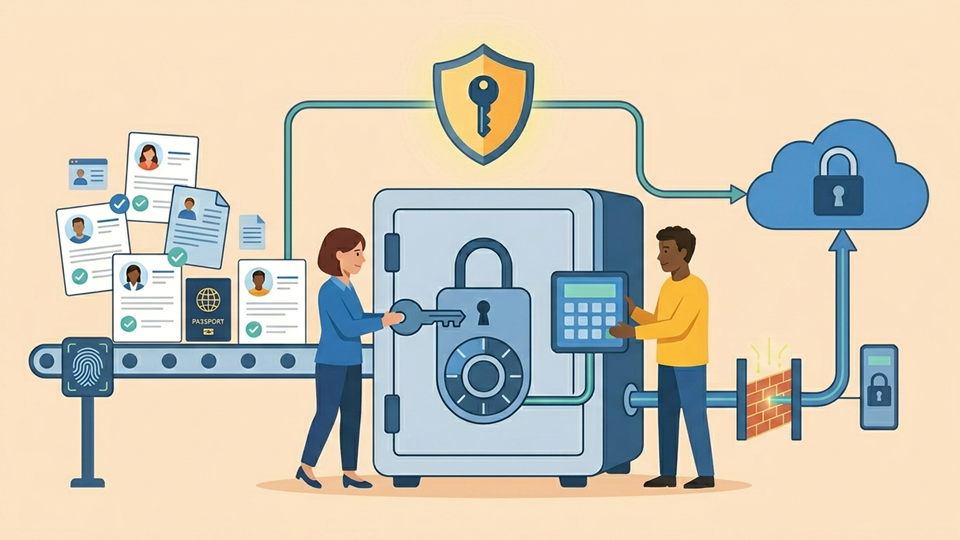
AI regulation is becoming part of everyday hiring governance
Artificial intelligence is now embedded in recruitment workflows, from CV screening and candidate matching to chatbots, assessments, interview scheduling, and automated recommendations. In 2026, the question for recruiters is no longer whether AI will influence hiring. It is whether the organization can demonstrate that its use of AI is lawful, fair, transparent, and properly governed.
The regulatory environment is developing across multiple jurisdictions rather than through a single global framework. A company hiring in the European Union may face the EU AI Act alongside data protection and employment law. A UK employer must consider the UK GDPR, the Data Protection Act framework, the Equality Act 2010, and emerging guidance on automated decision-making. US employers may also need to comply with state and local rules governing automated employment decision tools.
For recruitment teams, this creates a practical challenge. Compliance cannot be delegated entirely to the software provider. The employer remains responsible for understanding how AI is used in its hiring process, what data is processed, what decisions are influenced, and what safeguards exist.
The EU AI Act makes recruitment a high-risk AI use case
The European Union has placed many AI systems used in employment and recruitment within the high-risk category. This includes systems used to analyse and filter job applications, evaluate candidates, or make decisions affecting access to employment. The classification is significant because high-risk systems are subject to stronger requirements around risk management, data governance, documentation, transparency, human oversight, accuracy, cybersecurity, and monitoring.
The EU AI Act entered into force in 2024, with obligations introduced in stages. The regulatory timetable has also evolved as implementation discussions and subsequent political agreements have refined the application dates. For employment-related high-risk systems, organizations should not assume that a single date provides a complete compliance deadline. The exact obligations can depend on the role of the organization, the type of AI system, and the applicable implementation timeline.
Recruiters should therefore create an inventory of AI tools used in the hiring process. A simple list might include a sourcing platform that recommends candidates, an ATS feature that ranks applications, a video interview analysis tool, a psychometric assessment, and a generative AI assistant used to summarize interviews. These tools may have very different regulatory profiles.
A particularly important distinction is whether AI merely assists a human or materially influences an employment decision. A tool that summarizes a CV for a recruiter is different from a system that automatically rejects candidates below a score threshold. The more directly a system affects access to employment, the more carefully the organization should assess its legal and operational risks.
UK recruiters must focus on automated decisions, transparency, and fairness
In the UK, AI recruitment compliance is closely connected to data protection and equality obligations. The Information Commissioner's Office has made automated decision-making in recruitment a significant area of regulatory focus. Its recent work has highlighted concerns that some employers may be using systems to make decisions with legal or similarly significant effects without sufficient meaningful human involvement.
For recruiters, the practical issue is not simply whether a human is somewhere in the overall process. Meaningful human involvement must be genuine and applied consistently. A recruiter who automatically accepts an AI recommendation without reviewing the underlying evidence may not provide meaningful oversight. Similarly, allowing human review only for candidates who complain can create an inconsistent process.
Organizations should be able to explain where automation is used and how it affects candidates. This includes being transparent about automated decision-making, explaining relevant consequences, and providing appropriate routes for candidates to challenge decisions or request human review where applicable.
Data protection requirements also remain central. Recruitment systems process personal data at scale, often including employment history, education, assessment results, interview notes, and potentially sensitive information. Before introducing an AI system, organizations should consider the lawful basis for processing, data minimization, retention, security, accuracy, and whether a Data Protection Impact Assessment is required.
For example, if an employer uses AI to rank applicants based on historical hiring data, it should understand what data was used to develop the system and whether historical patterns could reproduce discrimination. A model trained on a workforce that lacked diversity may identify past hiring patterns without understanding whether those patterns were appropriate.
Bias testing must become an ongoing operational process
One of the most important changes for recruiters in 2026 is the move away from treating AI bias testing as a one-time procurement exercise. A vendor may provide information about how its system was developed, but employers still need to understand how the tool performs in their own recruitment environment.
Bias can enter a process through training data, job descriptions, historical decisions, assessment design, data quality, or the way recruiters interpret AI outputs. Even a technically sophisticated system can produce problematic results when used with a particular population, language, role, or workflow.
A practical monitoring program should compare outcomes across relevant groups where lawful and appropriate. Recruiters might examine whether candidates from different demographic groups are disproportionately filtered out at a particular stage, whether assessment completion rates differ significantly, or whether a recommendation system consistently favors particular backgrounds.
Monitoring should also consider false negatives. If an AI screening tool rejects a candidate who would otherwise have been successful, the organization may never know unless it reviews the process. A candidate who is filtered out does not usually remain in the recruitment funnel long enough to provide feedback.
Recruitment leaders should establish clear ownership for this monitoring. The question should not be, “Does the vendor say the tool is unbiased?” It should be, “Who checks how this tool performs in our process, how often is it reviewed, and what happens when a problem is identified?”
Recruiters need an AI governance framework, not just an AI policy
A short internal policy saying that employees must use AI responsibly is not enough for a modern recruitment operation. Effective governance connects technology, legal requirements, recruitment processes, and accountability.
Organizations should document each AI use case and identify the decision it supports. For example, “AI generates interview summaries” presents a different risk profile from “AI automatically ranks candidates for interview.” The documentation should identify the data involved, the vendor, the purpose, the human role, the potential risks, and the controls in place.
Procurement is another important control point. Before purchasing an AI recruitment tool, companies should ask vendors how the system works at a meaningful level, what data is retained, whether customer data is used to train models, how bias is tested, how performance is monitored, and what documentation is available for compliance assessments.
Contracts should also clarify responsibilities. If an AI vendor changes a model, updates an algorithm, or introduces a new feature, the employer may need to reassess the impact on its recruitment process. A tool that was acceptable when purchased can create new risks after a significant change.
Recruiters should also maintain records of important decisions. If an AI recommendation contributes to rejecting a candidate, the organization should be able to identify the relevant process, the human decision-maker, and the information considered. Good audit trails are valuable not only for regulators, but also for internal quality control and candidate complaints.
What hiring teams should do now
In 2026, organizations do not need to abandon AI to reduce regulatory risk. They need to use it deliberately. The first step is to map every AI-supported activity across the recruitment lifecycle, including tools used by recruiters, hiring managers, agencies, and external assessment providers.
Next, classify each use case according to its impact. AI used to draft an email is not equivalent to AI used to rank candidates. AI used to summarize interview notes is not equivalent to AI used to determine whether a candidate progresses. This risk-based approach helps organizations focus their governance effort where it matters most.
Hiring teams should then review candidate-facing transparency. Candidates should not be left to guess whether AI is evaluating their application. Recruitment communications and privacy notices should accurately explain relevant uses of automation and the available rights or review mechanisms.
Human oversight should be designed into the workflow rather than added after a problem occurs. A recruiter should have enough information, authority, and time to question an AI output. Simply placing a human at the end of an automated process does not guarantee meaningful oversight.
Finally, companies should review their recruitment technology stack regularly. AI regulation is developing, and vendors are continuously adding new capabilities. A system that originally provided administrative automation may later introduce candidate scoring, generative recommendations, or predictive features. Each change should trigger a review of its impact.
For ATS providers and employers alike, compliance is becoming part of the quality standard for AI-enabled recruitment. Platforms such as Zamdit can support a more controlled approach by bringing candidate data, assessments, interview questionnaires, scorecards, and hiring decisions into a structured recruitment workflow. When AI is used alongside clear human review, documented processes, and consistent evaluation criteria, organizations are better positioned to benefit from automation without losing accountability.