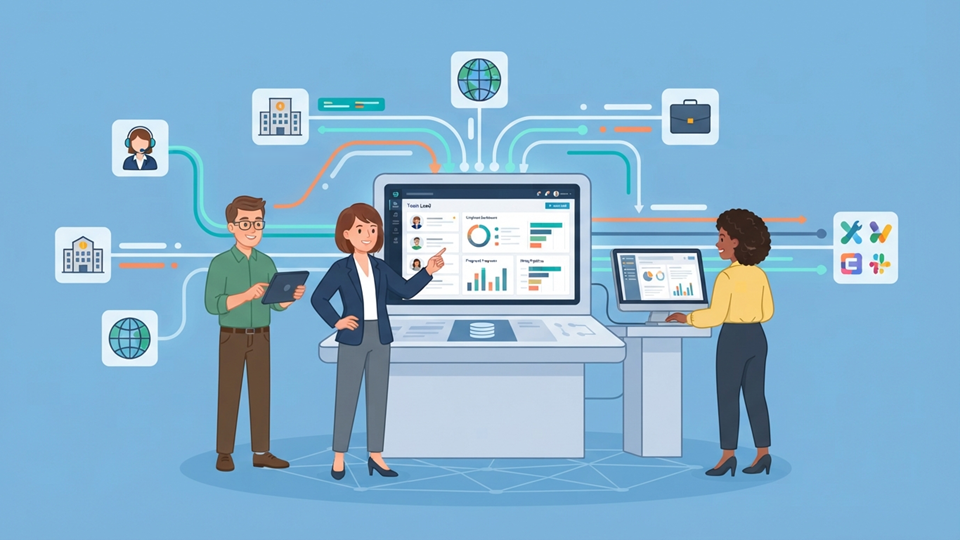
Why recruitment data becomes fragmented as organizations grow
Recruitment data rarely becomes fragmented because companies deliberately choose to create disconnected systems. It usually happens gradually. A recruiter stores candidate information in an ATS, a hiring manager keeps interview notes in a document, an agency sends profiles by email, and a department maintains its own spreadsheet of open positions. Over time, the organization has multiple versions of the same recruitment information, each with different levels of accuracy.
This fragmentation creates operational costs that are easy to underestimate. Recruiters spend time searching for information instead of engaging with candidates. Hiring managers ask for updates that already exist somewhere else. Candidates may be contacted by multiple people from the same organization. Leadership receives reports based on incomplete or inconsistent data. When recruitment activity increases, these problems become more visible and more expensive.
Centralizing recruitment data is therefore not simply a technology project. It is an operating model that gives the organization a consistent source of information about candidates, vacancies, hiring activity, communication, assessments, interviews, and decisions. The objective is not to store every possible piece of information in one system. The objective is to make important recruitment data available to the people who need it, when they need it, with clear ownership and appropriate access.
Define what should be centralized and establish a single source of truth
The first step is to identify the recruitment information that the organization needs to manage consistently. Candidate profiles are an obvious starting point, but centralization should usually extend further. Relevant data can include contact details, applications, resumes, interview feedback, assessment results, scorecards, recruiter notes, communication history, source information, hiring stages, job requisitions, and final outcomes.
Organizations should also define which system is authoritative for each type of information. For example, the ATS may be the source of truth for candidate status and hiring pipeline activity, while a payroll system may become authoritative after an employee is hired. A CRM may contain broader relationship data, but it should not automatically become the source of truth for every recruitment decision.
This distinction prevents a common mistake: attempting to synchronize everything with everything. Not every system needs a complete copy of every record. A well-designed architecture identifies the primary owner of each data domain and defines how information moves between systems.
Consider a company with five departments hiring independently. If each department maintains its own candidate spreadsheet, the organization may not realize that the same candidate has already applied for another role. A centralized candidate record can provide visibility across the organization while still allowing each hiring team to manage its own recruitment workflow.
Duplicate records are another significant problem. The same person may appear under different email addresses, name variations, or applications. Centralization should therefore include a clear approach to identifying and managing duplicate candidates. A single candidate profile with multiple applications is generally more useful than several disconnected records that obscure the candidate's relationship with the organization.
Connect the recruitment workflow, not just the database
Centralizing data is most valuable when it is connected to the actual recruitment workflow. A central database that still requires recruiters to manually copy information between systems does not eliminate the underlying operational problem.
The recruitment process should define where information is created, who is responsible for updating it, and how other stakeholders access it. When a candidate applies, the application should enter the appropriate workflow. When an interview takes place, feedback should be recorded where the hiring team can access it. When an assessment is completed, the result should be associated with the correct candidate and vacancy. When a decision is made, the outcome should be recorded as part of the recruitment history.
This creates a continuous record rather than a collection of isolated events. A hiring manager should be able to see that a candidate applied, completed a relevant assessment, attended two interviews, received feedback from multiple interviewers, and progressed through the defined stages without asking several people for separate updates.
Standardized workflows are particularly important for organizations with multiple departments or locations. If every team uses different stage names, definitions, and decision processes, reporting becomes difficult even when the underlying data is stored in one platform. A company may have “Phone Screen,” “Initial Call,” “Recruiter Interview,” and “Introductory Interview” that all represent approximately the same activity.
Standardization does not mean forcing every role to follow an identical process. A software engineering role and a sales role may require different assessments and interview stages. The organization can preserve flexibility while standardizing the underlying data structure, terminology, ownership, and reporting requirements.
Make recruitment information accessible to the right people
Centralization does not mean that everyone should have unrestricted access to every candidate record. Recruitment data often includes personal information, confidential interview feedback, compensation details, and sensitive hiring decisions. A centralized system therefore needs a clear permission model.
Recruiters may require broad access across multiple vacancies, while hiring managers may need access to candidates associated with their teams. Interviewers may only need to submit and review specific feedback. External recruiters may need controlled access to candidates they have submitted without seeing confidential internal notes or unrelated vacancies.
Role-based permissions help organizations balance collaboration with confidentiality. The principle should be simple: people should have access to the information necessary for their responsibilities, but not automatically to everything stored in the recruitment platform.
Access also needs to be practical. If information is technically centralized but hiring managers cannot easily find it, they will create alternative systems. This is how spreadsheets and private documents return to the process. Search, filters, candidate comparisons, dashboards, and clear workflows are not merely convenience features. They directly influence whether teams actually use the centralized system.
For example, a hiring manager reviewing ten candidates should be able to compare relevant qualifications, assessment results, interview feedback, and progression without opening multiple unrelated records. The easier it is to access structured information, the less incentive there is to maintain a separate personal tracking document.
Turn centralized data into operational visibility
The business value of centralizing recruitment data becomes clearer when the organization uses that information to improve decisions. A centralized system can reveal where candidates are being lost, which roles take longest to fill, which sources generate qualified applicants, and where hiring teams experience delays.
Useful metrics can include time to hire, time in each recruitment stage, application-to-interview conversion, interview-to-offer conversion, offer acceptance, source performance, assessment completion, and candidate withdrawal. These metrics become much more reliable when they are generated from consistent data rather than manually assembled spreadsheets.
For example, an organization might believe that a particular job board is its most effective source because it generates a high number of applications. Centralized data may show that another source produces fewer applications but significantly more interviews and hires. Without connecting the complete recruitment journey, the organization may continue investing in volume rather than quality.
Centralized data also improves workforce planning. If leadership can see the number of open positions, the current stage of each vacancy, the expected hiring timeline, and the availability of qualified candidates, recruitment capacity can be managed more effectively. Hiring managers can identify bottlenecks before they become critical.
Historical data can also support better forecasting. A company that consistently takes 45 days to fill a particular type of role should plan accordingly rather than assuming every vacancy can be filled within two weeks. Data does not eliminate uncertainty, but it makes planning more realistic.
Build governance into the recruitment data strategy
Centralization increases the importance of data governance. When recruitment information is scattered across individual spreadsheets and email accounts, the organization may not know exactly where all data exists. When it is centralized, the organization has a clearer opportunity to define retention, accuracy, security, and accountability.
Data quality should have clear ownership. Someone should be responsible for ensuring that candidate statuses are updated, duplicate records are managed, mandatory information is completed, and outdated records are handled according to the organization's retention policies.
Auditability is also valuable. A recruitment team may need to understand who changed a candidate's status, when an interview scorecard was submitted, or how a decision progressed through the hiring process. A clear activity history can provide useful operational context and support internal reviews.
Organizations should also review integrations carefully. Every connection between an ATS, job board, assessment provider, calendar, email platform, or HR system creates a potential point of failure. If an integration stops synchronizing correctly, inaccurate information can quickly spread across workflows. Monitoring and clear ownership are therefore essential.
For companies implementing a centralized approach, the most effective strategy is usually incremental. Start with the core recruitment process, establish reliable candidate and vacancy data, then connect assessments, interview workflows, communication, reporting, and external collaborators. This avoids the risk of building a complex system before the organization has agreed on the processes it needs to support.
A modern ATS can serve as the operational center of this model. Zamdit brings candidate records, hiring pipelines, interview questionnaires, assessments, scorecards, candidate comparison tools, collaboration, and external recruiter workflows into a structured environment. For organizations that want recruitment information to be accessible without losing control, centralizing these processes can replace fragmented tracking with a more reliable operating model.