Why traditional interview feedback creates inconsistent hiring decisions
Despite significant investments in recruiting technology and talent acquisition strategies, many organizations still rely on interview feedback processes that are largely subjective. Hiring managers and interviewers often complete evaluations based on intuition, memory, or personal impressions rather than structured criteria. As a result, candidate assessments vary widely between interviewers, teams, and hiring cycles.
Research in talent acquisition and organizational psychology has consistently shown that unstructured interviews are among the least reliable predictors of job performance. Factors such as first impressions, similarity bias, recency bias, confirmation bias, and interviewer confidence frequently influence hiring decisions more than objective evidence.
For organizations hiring at scale, this lack of consistency creates significant business risks. Strong candidates may be rejected due to subjective opinions, while weaker candidates may progress because of interpersonal chemistry or interview performance that does not correlate with actual job success.
One of the most effective ways to improve interview quality, consistency, and hiring outcomes is the implementation of structured interview scorecards. When designed correctly, scorecards transform interview feedback from personal opinion into measurable evaluation data that supports better decision making.
Organizations that implement structured interviewing frameworks often report improvements in quality of hire, interviewer alignment, diversity outcomes, and hiring efficiency. The objective is not to eliminate human judgment, but to ensure that judgment is supported by evidence and consistent evaluation standards.
What makes an interview scorecard effective
An interview scorecard is a structured evaluation framework used by interviewers to assess candidates against predefined competencies, skills, behaviors, and role-specific requirements. However, simply creating a scoring form does not automatically improve hiring outcomes.
Effective scorecards share several characteristics. First, they evaluate competencies that are directly linked to successful job performance. Rather than assessing vague attributes such as "culture fit" or "overall impression," high-performing organizations define specific criteria that can be observed and measured during interviews.
For example, a scorecard for a sales manager role might include competencies such as stakeholder management, negotiation skills, strategic thinking, data analysis, communication effectiveness, and leadership capability. Each competency should include behavioral indicators that help interviewers evaluate performance consistently.
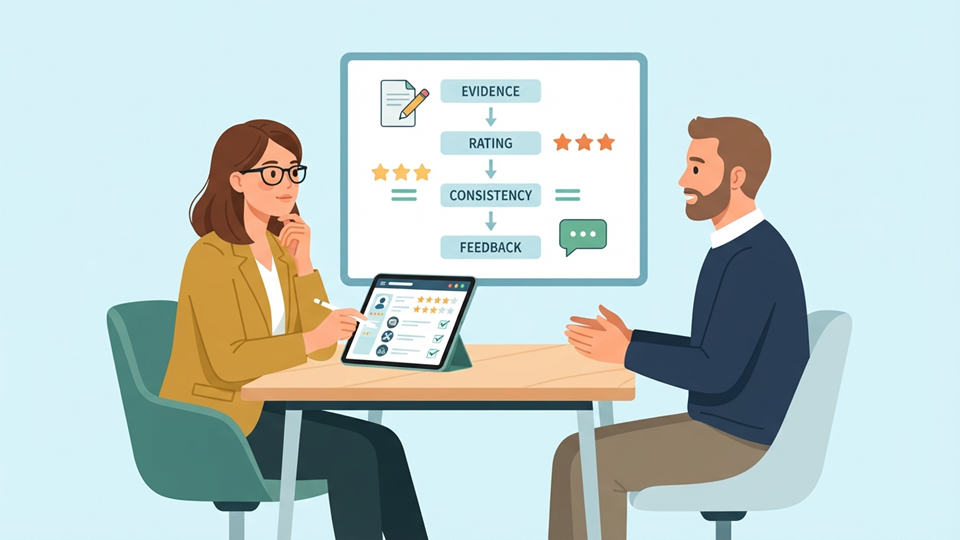
Second, effective scorecards separate observations from conclusions. Interviewers should document specific examples, responses, and behaviors observed during the interview before assigning ratings. This approach reduces the influence of memory bias and subjective interpretation.
Third, scorecards should use clearly defined rating scales. Generic scales such as "poor," "average," and "excellent" often lead to inconsistent interpretation. Instead, organizations should define what performance looks like at each rating level, creating shared standards across interviewers.
The goal of a scorecard is not to generate mathematical precision, but to create a structured framework that supports evidence-based hiring decisions.
Designing scorecards that improve hiring quality
Define competencies based on business outcomes
The most common mistake organizations make when creating scorecards is evaluating too many competencies. Comprehensive scorecards often become burdensome, reducing interviewer engagement and increasing inconsistency.
Most roles can be effectively evaluated using five to eight critical competencies directly linked to successful performance. These competencies should be identified through collaboration between hiring managers, recruiters, department leaders, and high-performing employees already performing similar roles.
For example, an engineering leadership position may prioritize technical decision-making, stakeholder communication, strategic planning, coaching ability, and execution management. A customer success role may prioritize relationship management, problem-solving, communication skills, empathy, and business acumen.
Organizations should regularly review competency frameworks to ensure alignment with evolving business objectives and market requirements.
Create behavioral indicators for every competency
One of the most powerful ways to improve objectivity is to define observable behaviors associated with each competency. Rather than asking interviewers whether a candidate demonstrated leadership, organizations should specify what leadership behaviors look like in practice.
For example, a leadership competency could include indicators such as resolving team conflicts, influencing cross-functional stakeholders, providing constructive feedback, managing organizational change, and coaching underperforming employees.
Similarly, problem-solving competencies may include identifying root causes, analyzing data, considering alternative solutions, evaluating risks, and implementing measurable improvements.
Behavioral indicators reduce ambiguity and help interviewers focus on evidence rather than intuition. They also improve consistency across different interview panels and geographical locations.
Use structured scoring scales
Rating scales should be accompanied by clear definitions. A five-point scale often provides sufficient granularity while remaining easy to use.
For example, a rating of one may indicate that evidence of the competency was not demonstrated, a rating of three may indicate acceptable proficiency, and a rating of five may indicate exceptional capability demonstrated through multiple examples.
Some organizations also incorporate confidence indicators, allowing interviewers to indicate whether their assessment is based on strong evidence or limited observations. This additional context helps hiring teams interpret scores more accurately during evaluation discussions.
Reducing bias through structured interview evaluation
Interview scorecards play a critical role in reducing unconscious bias during hiring processes. While no evaluation system completely eliminates bias, structured assessments significantly reduce the impact of subjective decision making.
Several common biases influence interview outcomes. Affinity bias causes interviewers to favor candidates with similar backgrounds, experiences, or personalities. Halo effects occur when one positive characteristic influences the overall evaluation. Confirmation bias leads interviewers to seek evidence supporting their initial impressions while ignoring contradictory information.
Structured scorecards mitigate these risks by requiring interviewers to evaluate predefined competencies independently. Interviewers focus on documented evidence rather than overall impressions, creating greater consistency across candidates.
Many organizations also require interviewers to submit scorecards before participating in debrief discussions. This practice prevents groupthink and reduces the influence of dominant personalities during hiring committee reviews.
Another effective practice involves assigning specific competencies to different interviewers. For example, one interviewer may evaluate technical skills, another may assess communication capabilities, while another focuses on leadership and collaboration. This specialization improves evaluation quality while reducing redundancy.
Organizations with mature structured interviewing programs frequently report improvements in diversity hiring outcomes because objective evaluation frameworks help minimize subjective barriers.
Integrating scorecards into modern hiring workflows
The effectiveness of interview scorecards depends heavily on how they are implemented within recruiting workflows. Paper forms, spreadsheets, and disconnected evaluation systems often reduce adoption and create administrative burdens.
Modern applicant tracking systems allow organizations to build customized scorecards directly into interview workflows. Recruiters and hiring managers can define competency frameworks, assign evaluation criteria to interviewers, collect structured feedback, monitor completion rates, and analyze historical hiring data.
Integrated scorecards also create valuable datasets that organizations can use to improve hiring outcomes over time. By comparing interview scores with employee performance, retention, and promotion metrics, organizations can identify which competencies are the strongest predictors of success.
As hiring becomes increasingly data-driven, structured interview scorecards are evolving from simple evaluation forms into strategic talent intelligence tools. Organizations seeking more consistent, fair, and effective hiring processes are increasingly incorporating structured scorecards into their recruiting operations. Platforms such as Zamdit help organizations centralize interview evaluation frameworks, standardize feedback collection, and support more objective hiring decisions across teams and locations.