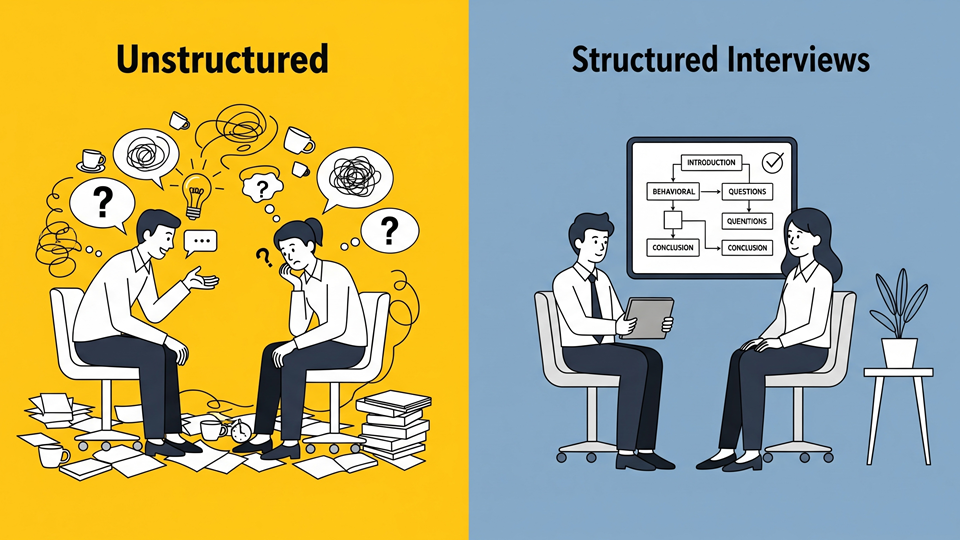
Interview fatigue is becoming a hiring risk
Interview fatigue is no longer just a candidate experience issue. It is a business risk that can slow hiring, weaken employer reputation and cause strong candidates to withdraw before a decision is made. In competitive markets, talented professionals speak with several employers at the same time. A process that requires repeated interviews, duplicated questions and long gaps between stages can make an attractive opportunity feel inefficient or poorly coordinated.
The problem affects hiring teams too. Managers who repeatedly interview candidates without clear evaluation criteria become tired, inconsistent and more likely to rely on instinct. Recruiters spend additional time coordinating calendars, chasing feedback and explaining delays. The result is a longer time to hire without a corresponding improvement in decision quality.
Interview fatigue usually develops gradually. A company adds an extra stakeholder after a weak hire, introduces another technical stage to reduce risk, or schedules a final leadership interview because senior executives want visibility. Each decision may seem reasonable in isolation, but the combined process can eventually require five, six or more conversations for a role that could be assessed effectively in three structured stages.
There is also a hidden opportunity cost. Candidates who are employed must repeatedly rearrange their working day, prepare for similar conversations and maintain momentum through a process that may last several weeks. Senior or sought-after candidates are unlikely to tolerate unnecessary friction. By the time an employer is ready to make an offer, another company may have moved faster.
More interviews do not automatically create better decisions
The assumption behind long interview processes is usually that additional meetings reduce hiring risk. In practice, extra stages only add value when they collect new and relevant evidence. If three interviewers ask similar questions about career history, motivation and strengths, the company is not gaining three times more insight. It is mostly repeating the same assessment with different people.
A more effective process starts by defining what each stage must prove. For example, an initial recruiter conversation can confirm motivation, communication, availability and basic suitability. A structured hiring manager interview can assess experience against the role's core competencies. A practical assessment or focused final interview can validate the remaining areas of uncertainty. Every stage should have a purpose that is distinct from the others.
Structured scorecards are useful because they force the hiring team to decide what matters before meeting candidates. Instead of asking whether someone was "impressive," interviewers can evaluate specific factors such as stakeholder management, commercial judgment, technical depth, leadership, problem solving or customer communication. This makes feedback easier to compare and reduces the temptation to add another interview because the existing feedback feels vague.
Companies should also separate assessment from stakeholder exposure. A candidate may need to meet future colleagues or senior leaders, but not every conversation has to become a formal interview. For a senior commercial hire, for example, two structured interviews and a practical case discussion may provide sufficient evidence. A short informal meeting with the CEO can then focus on alignment and questions rather than introducing another round of scoring.
Panel interviews can reduce repetition when several stakeholders need to assess the same area. However, they work best when roles are assigned in advance. One interviewer might focus on technical judgment, another on collaboration and another on delivery. Without coordination, panels can become exhausting sessions where candidates answer variations of the same question several times.
How to streamline hiring without lowering the bar
Streamlining does not mean making hiring easier or reducing standards. It means removing steps that do not materially improve the decision. The first step is to map the current hiring journey from application to offer and identify where information is duplicated. Recruitment teams are often surprised by how many stages exist because different departments have gradually added their own requirements.
A useful target for many professional roles is three meaningful decision stages after application screening. The exact structure will vary by role, but a common model is an initial recruiter conversation, a structured competency interview and a final practical or leadership stage. Technical, regulated or executive positions may require more, but each additional step should have a clear justification.
Practical assessments should also be proportionate. A two-hour case study may be reasonable for a senior role when it closely reflects the work and replaces several interviews. Asking candidates to complete extensive unpaid projects, prepare detailed business strategies or attend multiple assessment sessions can create another form of fatigue. The goal is to obtain enough evidence to make a confident decision, not to test how much inconvenience a candidate will accept.
Scheduling speed matters as much as the number of stages. Three interviews spread across four weeks can feel more exhausting than three interviews completed within several days. Where possible, recruiters can reserve interview blocks in hiring managers' calendars before sourcing begins, combine compatible stages on the same day and set internal deadlines for feedback. A candidate should not wait a week because one interviewer has not submitted notes.
Feedback discipline is critical. Interviewers should record their evaluation independently before discussing the candidate with colleagues. This helps reduce groupthink and prevents the most senior or confident person in the room from shaping everyone else's opinion. A centralized Applicant Tracking System can make this easier by collecting scorecards, comments and recommendations in one place.
Recruitment teams should also define decision rules in advance. If a candidate performs strongly across all essential competencies but is weaker in one desirable area, does the process continue or stop? If two interviewers disagree, what evidence is needed to resolve the difference? Clear rules prevent organizations from adding interviews because they are uncomfortable making a decision.
Protecting candidate experience while improving hiring quality
A streamlined process should feel deliberate, not rushed. Candidates need to understand the stages, who they will meet, what will be assessed and when they can expect a decision. Providing this information early reduces uncertainty and signals that the organization manages recruitment professionally.
Communication becomes important when delays cannot be avoided. If a decision is postponed because a key stakeholder is unavailable, a short update is better than silence. Candidates rarely expect every process to move perfectly, but they notice when communication disappears. Regular, updates can preserve engagement even when scheduling becomes difficult.
Recruiters can also improve the experience by avoiding unnecessary repetition. Interview notes should be visible to the hiring team so candidates do not have to explain the same background in every conversation. Later interviewers can acknowledge what has been discussed and use their time to explore different evidence. This creates a more natural progression through the process.
Candidate withdrawal should be treated as useful operational data. If strong candidates frequently leave after a particular stage, the company should investigate why. The issue may be the length of the process, an overly demanding assessment, slow scheduling or a mismatch between the job description and what interviewers communicate. Tracking withdrawal reasons can reveal problems that internal hiring metrics do not show.
Organizations should measure more than time to hire. Interview-to-offer ratio, candidate withdrawal rate, assessment completion rate, feedback turnaround and offer acceptance can show whether a process is both efficient and credible. A shorter process that leads to poor hiring decisions is not an improvement, but neither is a elaborate process that drives away qualified people.
A faster process can still be a more rigorous one
The strongest hiring processes in 2026 are likely to be those that collect better evidence with fewer unnecessary interactions. Employers do not need to choose between speed and quality. Structured interviews, clear scorecards, focused assessments and disciplined feedback can make decisions more rigorous while reducing the number of meetings candidates must attend.
The principle is simple: every stage should answer a question that has not been answered. If the hiring team cannot explain what new evidence an additional interview is expected to provide, that stage probably needs to be redesigned or removed.
For recruitment teams using Zamdit, centralized candidate profiles, structured scorecards, assessments, interview workflows and shared feedback can help reduce duplication while preserving decision quality. A well-configured Applicant Tracking System should make the hiring process easier to coordinate, not digitize an overly complicated sequence of interviews. When companies remove unnecessary friction and keep evaluation focused on relevant evidence, they can move faster without losing the great candidates they are trying to hire.